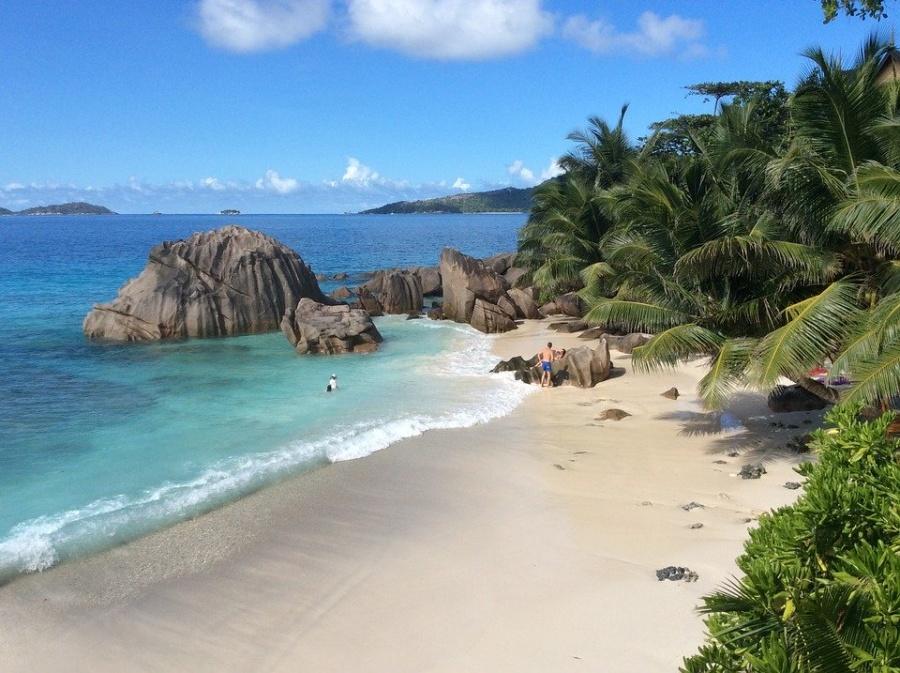
 The Seychelles is one of the most popular holiday destinations for sea and nature lovers. This archipelago, located northeast of Madagascar and washed by the Indian Ocean, is a natural wonder that is hard to forget.
Made up of 155 islands, including atolls, coral and granite islands, this archipelago has natural beauty that has earned it a place on the UNESCO World Heritage list. Visiting it is undoubtedly everyone's dream, but to do so requires a few tips and information about its climate.
Best time
Month | Average temperatures (min/max) | Precipitation (days/mm) |
|---|---|---|
January | 24 / 30° | 17 days / 380 mm |
February | 25 / 30° | 11 days / 260 mm |
March | 25 / 31° | 11 days / 165 mm |
April | 25 / 31° | 14 days / 175 mm |
May | 25 / 31° | 11 days / 125 mm |
June | 25 / 29° | 10 days / 65 mm |
July | 24 / 28° | 10 days / 80 mm |
August | 24 / 28° | 10 days / 95 mm |
September | 24 / 29° | 11 days / 120 mm |
October | 24 / 30° | 12 days / 205 mm |
November | 24 / 30° | 14 days / 215 mm |
December | 24 / 30° | 18 days / 280 mm |
To say which is the best time of year for a holiday in the Seychelle is practically impossible, as you will always find warmth and good weather here, even during the wet season, which sees frequent rain in the form of thunderstorms. However, depending on your travel needs, it is good to make a few clarifications about the climate.
Inner Islands (Mahé, Praslin, Silhouette): they represent more than 50% of the entire Seychelles territory. They have high temperatures all year round but are very rainy. In some months, such as December, it can rain for more than two weeks.
Outer Islands(Amirante, Alphonse, Aldabra): climate and temperatures similar to the inner islands but less rainy. The outer islands are mainly coral groups and can be more affected by phenomena such as cyclones.
Probably the best time to visit the Seychelles is in spring and autumn (April-May and October-November), so as to avoid the trade winds of summer (June-August) and the heavier rains of winter (December-February). During these months, temperatures are high and there are no winds, so the beaches are more algae-free and the visibility of the seabed is excellent. There is the possibility of some rain, but it usually lasts half an hour and then the sun returns.
Our summer (June-August) is windier and therefore ideal for water sports (surfing, kiting, windsurfing, sailing, ...). However, the rougher sea reduces the visibility of the seabed and can bring algae to the beaches (especially in Praslin). The windiest months are July and August.
Period to avoid
 Thereare no particular periods to avoid when visiting the Seychelles. Even the rainy season, from December to March, is sunny and the downpours are intense but short-lived.
Of course, the high humidity, which reaches 80%, is not the best for enjoying the beauty of these islands.
On the outer islands further south, tropical cyclones can form in November-December and April-May. These cyclones mainly affect the southernmost outer islands (especially Aldabra and Farquhar), while the northern islands are barely touched by them.
Climate and seasons
 The Seychelles is characterised by a tropical climate with high temperatures throughout the year with little temperature variation.
There are two seasons here: the first is the wetter season, with frequent rain and high humidity, which runs from December to March. The second is the drier one, with slightly lower temperatures, which runs from June to September.
Average Temperatures and Precipitation - Inner Islands (Mahé, Praslin, Silhouette)
The Inner Islands are characterised by more intense rainfall than the southern islands and high humidity, with about 200 rainy days per year. The temperature on these islands barely exceeds 30° in the hottest months, which are also the months with the most rain, while the lows remain constant at around 25°. Sunshine is abundant in every month of the year, ranging from a minimum of 5 hours of sunshine from December to February, to a maximum of 8 hours in the dry season months.
Recommended periods: April-May and October-November. From June to September, ideal wind conditions for water sports (surfing, kiting, windsurfing, sailing, etc.).
Season | Period | Temperatures (min/max) | Rainy days |
|---|---|---|---|
Dry season | June-September | 24°/29° | 41 |
Wet season | December-March | 24°/31° | 108 |
Transition months | April-May and October-November | 24°/31° | 64 |
Average Temperatures and Precipitation - Outer Islands (Aldabra, Alphonse, Amirante group)
The Outer Islands are poor in precipitation compared to the Inner Islands such as Mahé and Praslin, with a difference of up to 1,000 mm per year (around 900 for the Aldabra Islands compared to 1,900 for Birds Island), while there are no major differences in temperatures. These sunny islands have decidedly warm waters, with temperatures ranging between 24 and 31°.
These outer islands can be affected by tropical cyclones in November-December and April-May. These cyclones mainly affect the outer islands further south (especially Aldabra and Farquhar), while the northern islands are barely touched by them.
Recommended period: June to September
Season | Period | Temperatures (min/max) | Rainy days |
|---|---|---|---|
Dry season | June-September | 24°/29° | 19 |
Wet season | December-March | 24°/31° | 49 |
Transition months | April-May and October-November | 24°/28° | 41 |
What to pack
Dry season (June-September) | Wet season (December-March) | Intermediate months (April-May and October-November) |
|---|---|---|
light clothing, sun protection, swimwear and beachwear, kite or surfing equipment, some wind jackets | like the dry season, but with a mackintosh and umbrella for downpours | light clothing, sun protection, swimwear and beachwear, snorkelling equipment |
Useful info
Capital: Victoria
Population: 85,033
Surface area: 455 km2
Languages: English, French, Seychelles Creole
Currency: Seychelles Rupee (SCR) / Exchange rate: €1.00 = 14.71
Documents: passport, return air ticket for a stay not exceeding 30 days.
Time zone: +3 h compared to Italy, +2 h when daylight saving time is in force in Italy
Vaccinations: not required